Frightening: The Playful Yet Spooky Display Font for Halloween
When October rolls around, the visual landscape shifts. We see a surge of cobwebs, pumpkins, and a specific kind of typography that aims to be both eerie and inviting. For designers, marketers, and content creators, finding a font that captures that festive spirit without tipping into pure horror is a common challenge. Enter Frightening, a premium display font engineered specifically for this niche. It’s not just another spooky typeface; it’s a carefully crafted design asset that balances bold, playful energy with classic Halloween aesthetics.
Visual Anatomy of a Whimsical Ghoul
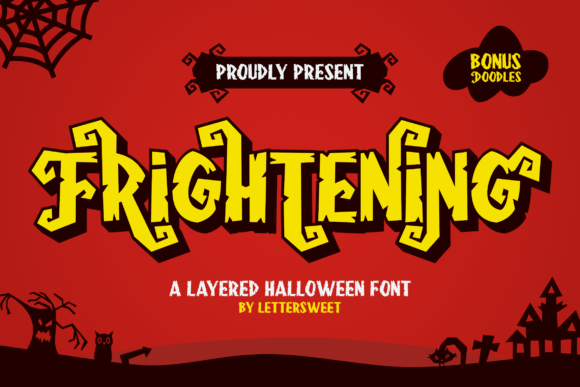
At first glance, Frightening commands attention. Its characters are thick, exaggerated, and built with sharp, irregular edges. Think of the classic lettering you’d see on a vintage horror movie poster, but filtered through a cartoonist’s lens. The strokes are jagged, and many letters incorporate curling, vine-like elements that suggest creeping fingers or twisting branches. This isn’t a delicate script font or a clean sans serif font; it’s a heavyweight display font designed for impact.
The true magic, however, lies in its layered construction. Frightening is often provided with multiple layers or color variations, allowing you to stack effects. You can apply a base color, add a shadow layer for depth, and perhaps an outline for definition. This dimensionality is a game-changer for creating posters, social media graphics, or packaging design that pops off the screen or page. It gives you the tools to build a rich, tactile feel that a flat, single-weight typeface simply cannot achieve.
Strategic Applications: Beyond the Party Invitation
While its personality screams Halloween, the applications for a font like Frightening are surprisingly strategic. For small business owners and entrepreneurs in seasonal retail, this typeface is a cornerstone of brand identity during the fall months. Imagine it on a bakery’s window decal for pumpkin spice season, on a craft brewery’s limited-edition stout label, or as the headline for a haunted attraction’s marketing campaign. It instantly communicates the theme, sets the mood, and ensures brand consistency across all touchpoints.
For digital creators and bloggers, Frightening solves the problem of standing out in a crowded content feed. A YouTube thumbnail using this font for a Halloween tutorial or a horror movie review immediately signals the content’s theme. It works powerfully in editorial design for seasonal magazine spreads or as section headers in a festive email newsletter. The key is to use it where its personality can shine—in headlines, titles, and short bursts of impactful text, rather than in long-form body copy where its intricate details could hinder readability.
Practical Considerations for Professional Use
Choosing a creative font like Frightening for a project involves more than just liking its look. As a designer or brand strategist, you need to evaluate its practical fit. First, consider readability. At a large scale on a poster, its details are clear. At 12 points on a website, it might become a tangled mess. Always test your font pairing with a highly legible companion. A simple, clean sans serif font or a neutral serif font for body text will create a necessary visual hierarchy, letting Frightening do the heavy lifting for headlines without sacrificing the user’s ability to read the finer points.
Next, scrutinize the included styles and commercial licensing. Does the font family come with just the base, or does it include the essential shadow and outline layers? For a commercial font, understanding the license is non-negotiable. Ensure it covers your intended use, whether for client work, merchandise, or digital products. A reputable type foundry will make this information clear, protecting both you and your client.
Building a Cohesive Seasonal Brand Identity
Consistency is the bedrock of professional branding. Using Frightening across a Halloween campaign—from the logo design concept for a seasonal event to the social media graphics, email headers, and printed flyers—creates a unified and memorable experience. The font becomes a recognizable asset, tying all elements together. Its playful, approachable nature makes it suitable for family-friendly events, while its underlying spookiness satisfies the classic Halloween vibe.
This approach demonstrates modern typography in action: using a specialized typeface not just for decoration, but as a strategic tool for audience engagement. The right font doesn’t just convey words; it conveys feeling. Frightening’s feeling is one of festive fun with a dash of delightful dread. It invites your audience into a specific seasonal world you’re building, making your marketing efforts more resonant and your creative projects more immersive.
In the end, Frightening is more than a novelty. It’s a well-executed design asset that understands its purpose. For anyone tasked with creating compelling Halloween-themed content—from the entrepreneur launching a seasonal product line to the designer crafting a client’s annual spooky promotion—it offers a perfect blend of character and functionality. It proves that within the realm of display typography, a font can be both frightening and fun, serious in its design and playful in its application.